


Challenge
A major snack foods brand had grown from a cult favorite in fitness communities to being sold in mainstream channels like Walmart and Target. Their product was clearly taking off, but the brand didn't understand why shoppers were choosing their bars over all the others in the aisle.
The company urgently wanted to innovate new snacks and expand their portfolio, but couldn't move forward without an understanding of how people make snack choices, and the jobs they hire bars to do on different occasions.
At a critical time in their growth story, the client hired Amplify to establish foundational user insights and a model of snack decision‑making that would ground their messaging, packaging, and new product development.
Our Process
Amplify conducted deep qual research in all the places consumers make snack decisions: in the supermarket, at home, and on the go.
We watched as they compared products side by side, peeked at the snacks they keep in their desks, and tested snack concepts with extreme forms and functions to probe what was most important or a turn off.
From that data, we created an insight system that:
- Identifies the decision variables that shoppers consider when making a snack decision
- Illustrates three personas at different stages of a health transformation journey
- Explains how consumers' own food rules, habits and preferences change in different contexts, and lead to different food choices
- Defines how to help each persona meet their goals for food function and taste through snack ingredients, form factor, flavors, and packaging
- Translates directly into product development, persona‑based marketing, and retail activation so cross‑functional teams can move faster together.
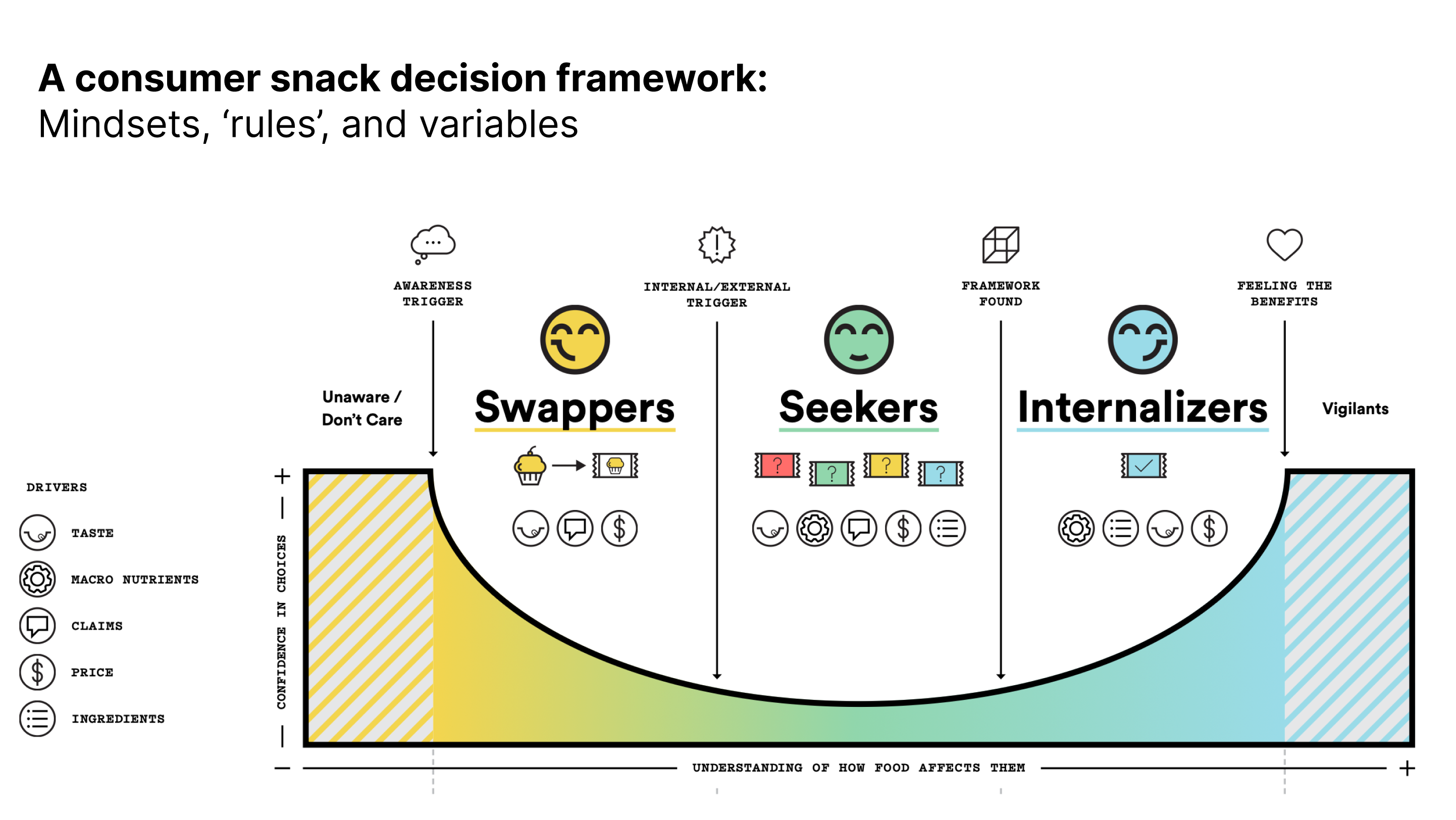
A decision framework and persona spectrum that put taste and health on one map.
1) Health ↔ Taste Spectrum with a movable middle
We surfaced three consistent mindsets that also map to stages of a health transformation journey:
- Swappers — Early Journey (taste‑first, small upgrades):
- People who want to swap out the obvious bad stuff without changing their life. They rely on quick rules ("low sugar," "no weird ingredients"), expect great taste and texture, and are price‑sensitive. They’ll choose the option that feels indulgent but claims to be better.
- Seekers — Middle Journey (balancing proof and pleasure): Actively learning and testing. They compare macros + ingredients, read labels, and want a reason to believe—but flavor must still deliver. They’ll pay more if the product proves it and doesn’t feel like a compromise.
- Internalizers — Late Journey (system builders, function‑first): Confident in their routines and targets. They optimize for performance and benefits (protein, energy, satiety), demand transparency, and will trade a little taste for function. Once a product fits their system, they’re loyal.
This spectrum shows why a single claim can attract one group and repel another, and how the same person moves on the spectrum by occasion (post‑workout vs. afternoon slump vs. kid snack).
2) Five decision variables that explain most choices
Taste • Macros • Claims • Ingredients • Price—reordered by persona and job‑to‑be‑done (meal replacement, treat, kid snack). This gave brand and shopper teams a reliable way to choose the lead cue and the right proof for each context. Examples: lead with taste/texture for Swappers, macro + taste lockup for Seekers, and functional benefit headline for Internalizers.
3) Activation‑ready tools
- Persona one‑pagers tied to the spectrum with trigger moments, decision order, taste expectations, and “what to prove.”
- Snack Choice Framework used as a checklist for pack/PDP hierarchy and creative briefs, including occasion‑by‑persona reordering of cues.
- Growth directions for formats and flavors that feel substantial for meal jobs while preserving indulgent cues for treat occasions; guidance for kid‑appropriate claims and textures.
Outcomes
- A common language across Marketing, Innovation, and Sales.
- Persona‑based messaging and retail playbooks anchored in what actually drives choice.
- Clear innovation focus areas linked to real consumer trade‑offs.
- Faster decisions: teams used the framework to review pack hierarchy, PDPs, pricing packs, and concept briefs.


%20(3).jpg)


