
Our favorite type of projects are the ones where we get to dive into the messy, emotional, and contradictory ways that humans make purchase decisions. But it's especially fun when we get to study decisions that are loaded with personal, cultural and health meaning.... like food.
We knew that what we choose to eat is not as straightforward as choosing what we want to eat, or what we think our body needs. But in this project, we wanted to understand the actual tradeoffs that consumers make, and how are those moments influenced by the environment, hunger, price, and everything else at play.
Observing real snack choices
This project was design research 101, but that didn't make it clear cut. We spent time with people in grocery aisles, at home, and on the go, watching how they navigated shelves, compared packages, and explained what made a snack feel like a “good" choice, a "treat" or "off limits".
Some people moved quickly through the aisle, barely pausing. Others slowed down, flipped bars and bags over, compared macros and ingredients, and cared about brands. In homes and workplaces, we saw the same contrast: some participants relied on a small, familiar rotation of snacks, while others actively experimented, tracked outcomes, and adjusted rules over time.
What stood out wasn’t confusion or indecision. It was different ways of reasoning.
Three distinct decision modes
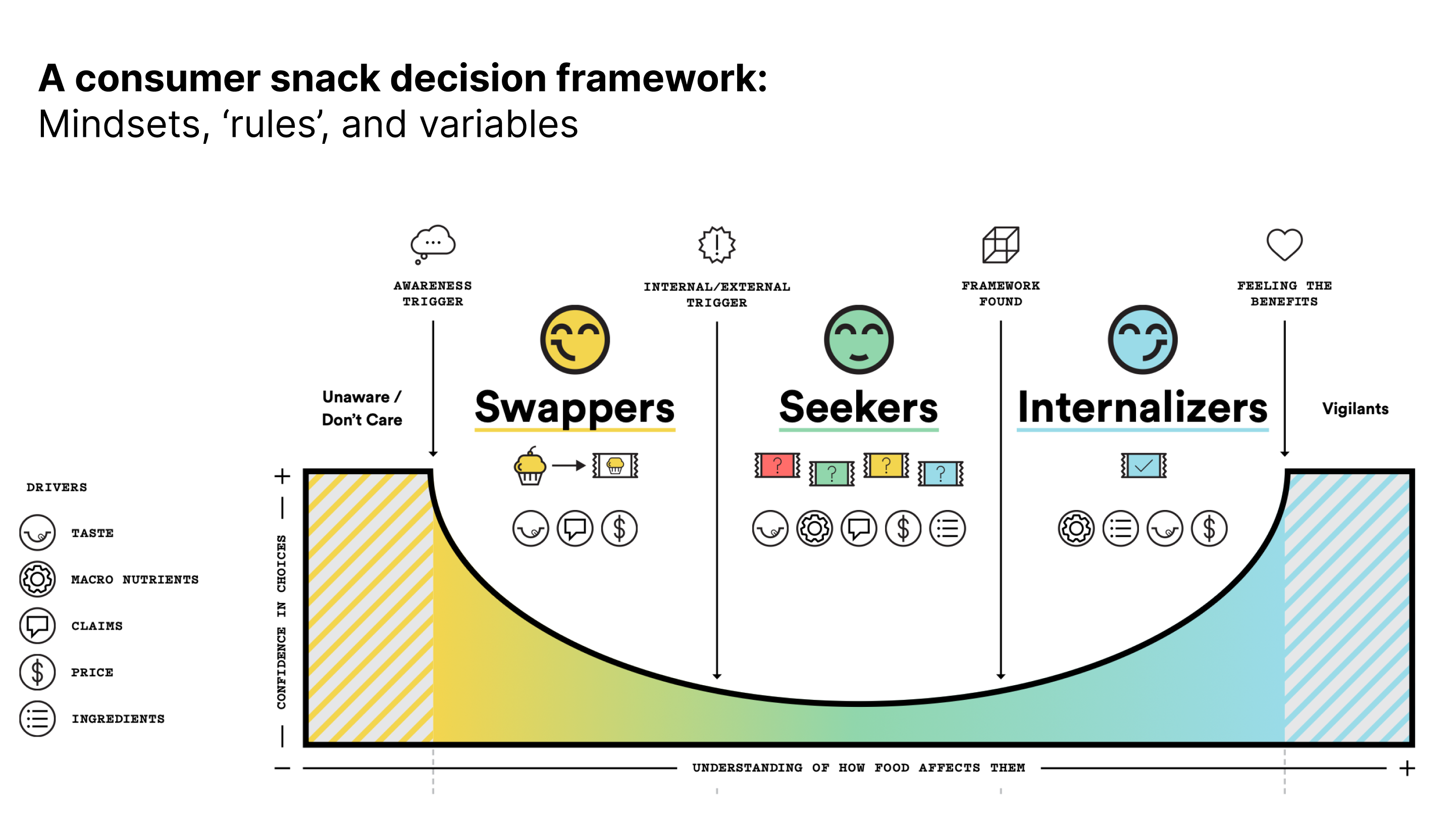
Across observations, interviews, and contextual prototyping exercises, we saw three consistent decision modes emerge—not as fixed personas, but as fluidstages people move through as they learn what works for them.
Swappers: early-stage rules
Swappers were trying to make better choices without thinking too hard. Their "food system" was new and fragile, and they gravitated towards simple, one off rules and ingredient swaps:
- “Low sugar”
- “High Protein"
- “Clean"
However, for Swappers, taste was non‑negotiable. Health claims worked only if they didn’t threaten enjoyment. One participant told us: “If it tastes like cardboard, I’m out. I don’t care how healthy it is.”
Seekers: comparison and testing
Seekers were actively learning about the functional effects of foods and noticing how changes made them feel. They compared macros, ingredients, and claims, often across brands and formats. However, absorbing all of this information could be overwhelming and lead to choice paradox.
One woman pulled up photos of labels she’d saved on her phone. “I’m trying to connect the dots,” she said. “I want to know what actually makes a difference.”
Seekers tolerated more effort and paid more attention—but they were also quick to reject anything that felt misleading or overpromised.
Internalizers: established systems
Internalizers had clear routines. They knew what worked for their body and goals, and could anticipate how different foods would make them feel.
“This fits my day,” one runner explained. “I don’t really experiment anymore.”
They prioritized function first—energy, protein, satiety—and expected transparency. Taste mattered, but as a qualifier, not a hook.
However, even though their food system was the most well-developed, internalizers could still allow flexibility and indulgences, if it was a part of their system.
The same variables, reordered
Across all three modes, the same five factors consistently showed up in decision-making: taste, macros, claims, ingredients, and price.
The difference wasn’t what people cared about—it was the order in which they evaluated those cues, and how much confidence they brought to the decision.
Early on, taste and price tended to dominate. In the middle, proof and information gained importance. Later, functional benefits and system-fit led, with taste acting as a qualifier rather than a hook.
Crucially, the same person often shifted modes by occasion—treat vs. meal replacement, personal snack vs. family purchase, routine vs. experimentation. And if they were stuck in an extreme scenario (think: starving on the commute home, in the airport with few good options, snacking at the movie theater) -- all bets could be off.
Turning insight into a usable model
Rather than treat these findings as static personas, we translated them into a decision framework that helped out client teams understand the variables shoppers considered in the snack aisle, and how those mapped to target consumers and snacking occasions.
Marketing, Innovation, and Sales gained a shared language for evaluating packaging hierarchy, messaging, and new product concepts—grounded not in assumptions, but in observed behavior.
